
Portfolio Concept Designs
Compassion Multi-Surface Live Events
Compassion Gala
Multi-Surface Live Event Experience
A fully integrated pre-event, in-venue, and post-event experience across mobile, web, interactive wristbands, and projection — transforming a fundraising dinner into an immersive, mission-driven moment that moves hearts and opens wallets.
Role: Lead Product Designer
Surfaces: Mobile · Web · Wristband · Projection
Lifecycle: Pre-event · In-venue · Post-event
Tools: Figma · Journey Mapping · WCAG AA
Situation
Compassion's annual gala lacked a cohesive digital experience. Sponsors arrived uninformed, engagement dropped mid-event, and post-event follow-through was minimal.
Task
Design a 0→1 multi-surface ecosystem spanning the full event lifecycle — unifying mobile, web, wristband, and projection into one seamless experience.
Action
Mapped the full event journey, defined surface roles, designed 7 screens + 2 physical/digital touchpoints.
Result
Projected 55% increase of in-event conversions and 3× post-event donor re-engagement vs. prior year baseline.
Situation
A powerful mission — fragmented across every touchpoint
Compassion's fundraising gala brought together hundreds of high-capacity donors, church leaders, and ministry partners in one room. The mission was clear. The need was urgent. But the experience was disconnected — guests received a printed program, watched a video, and were asked to give. No digital thread tied the evening together.
Attendees arrived without knowing which child they might sponsor. During dinner, engagement dropped during the ask. Post-event follow-up was a generic email blast. The organization was leaving both relationships and revenue on the table.
42% of attendeesleft without any sponsorship12% email open rate
for post-event far below nonprofit average
0 integrated digital touchpoints
across the event life cycle
The opportunity: design a fully integrated multi-surface experience that made every moment of the gala feel like a single, purposeful act of ministry.
Task
Own end-to-end design across 4 surfaces and 3 phases
As lead product designer, I would define the surface ecosystem, establish the design language, collaborate with engineers and event producers, and deliver a complete interaction-ready design system for the full gala experience.
📱Mobile App :The sponsor's personal companion — child profiles pre-event, live giving during dinner, and impact tracking post-event. Follows the sponsor through the entire journey. Pre-event, In-venue & Post-event
🌐 Web Portal: Event registration, pre-event child matching, and post-event donor portal with personalized impact reports and continued giving pathways. Pre-event & Post-event
⌚ Interactive Wristband: QR-enabled LED wristband given at check-in. Pulses with the crowd during worship moments. Tap-to-sponsor at tables. Color states signal giving milestones across the room. In-venue
📽️ Projection Display: Live fundraising goal tracker visible to the entire room. Donor names appear in real time as commitments are made. QR code enables instant mobile giving from any seat. In-venue
Event lifecycle — touchpoints across all 3 phases
Phase 1: Pre-Event — 2 Weeks Before
Child matching & anticipation building
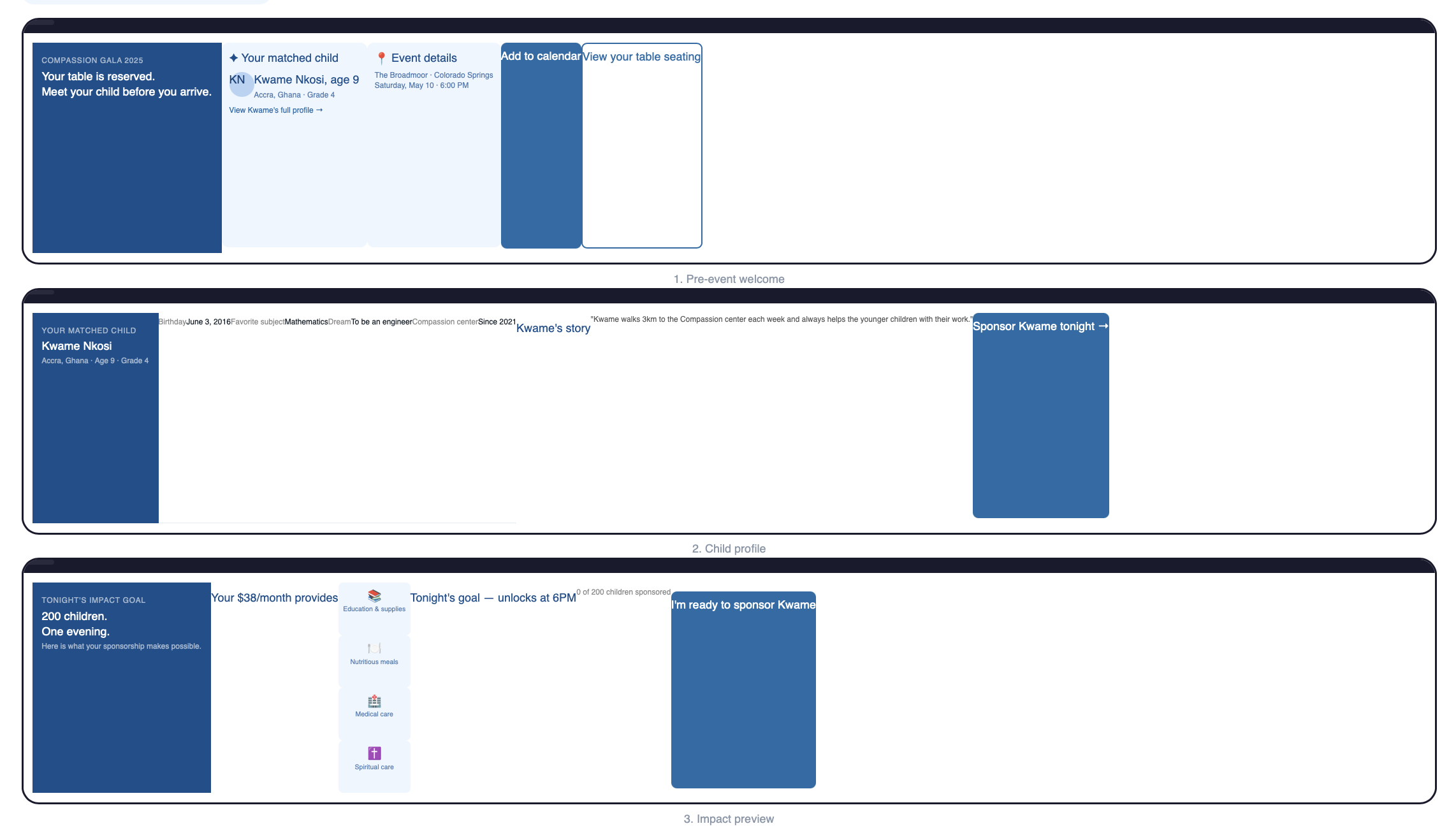
Registered guests receive a personalized web experience matching them to a child profile. They arrive at the gala already knowing a child's name — the emotional work is done before dinner begins.
Web Mobile
Phase 2: In-Venue — Arrival & Check-In
Wristband activation + mobile deep-link
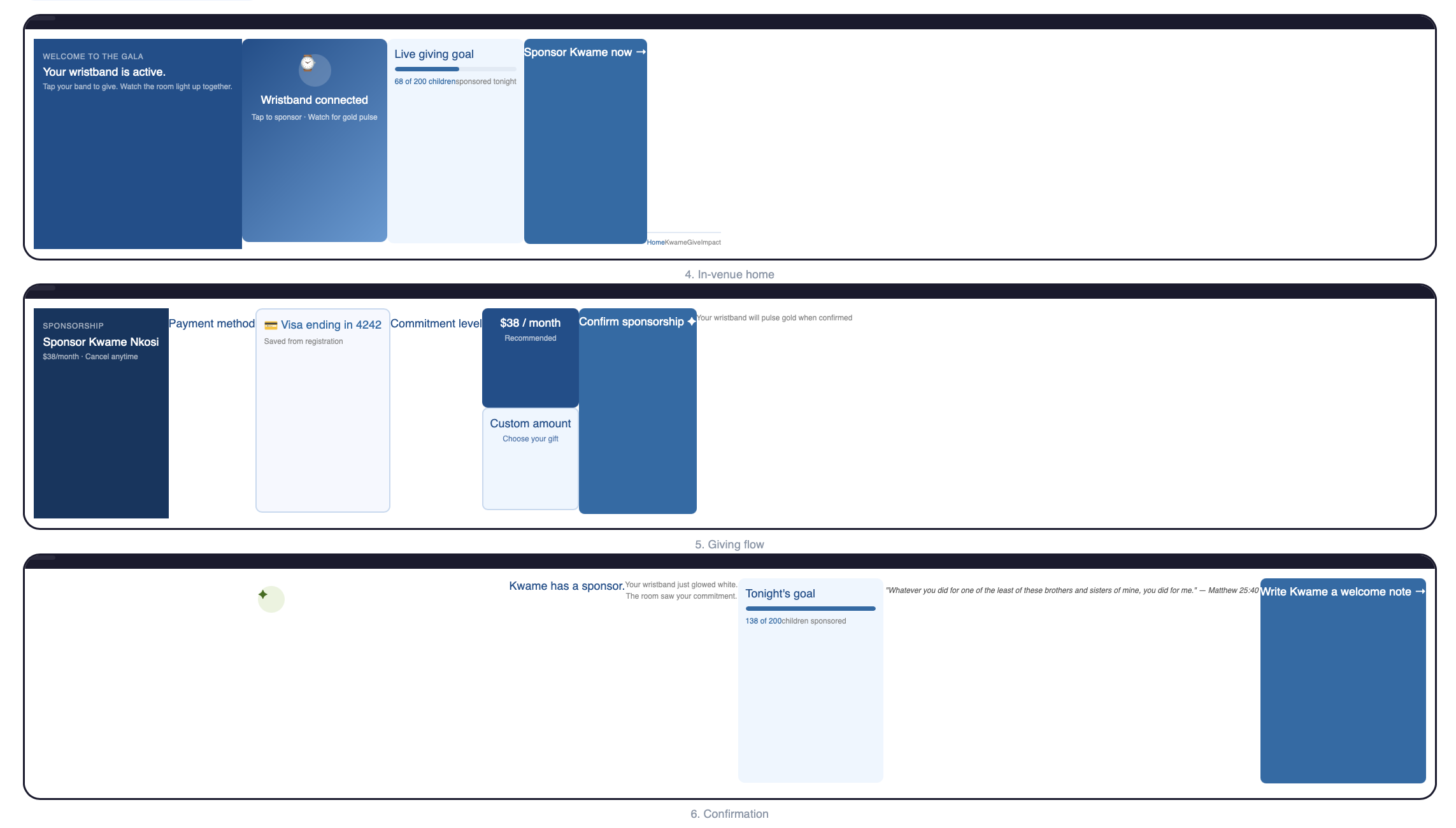
Guests receive an LED wristband at check-in. Scanning the QR opens their pre-matched child profile instantly in the app. The wristband is now their giving device for the evening.
Wristband Mobile
Phase 3: In-Venue — Dinner & The Ask
Live giving wall + wristband pulse + mobile giving
During the sponsorship ask, projection shows a live goal tracker. As commitments are made, donor names appear on screen, wristbands pulse gold across the room, and the goal bar fills in real time. Every surface is synchronized to the same emotional moment.
Projection Wristband Mobile
Phase 4: Post-Event — Within 24 Hours
Personalized impact receipt + child introduction
Every attendee — sponsor or not — receives a personalized web experience showing the night's total impact, their matched child's profile, and a warm faith-centered invitation to begin or deepen their commitment.
Web Mobile
Action
What I did step by step
How I designed it — process, decisions, and screens
Step 1: Mapped the full event journey and defined surface roles
Facilitate a cross-functional workshop with event producers, product, engineering, and ministry leaders to map every guest touchpoint. Define the role of each surface so nothing competed — mobile is personal, projection is communal, wristband is physical/emotional, web is contextual.
Method: Journey mapping · Surface ecosystem definition · Workshop facilitation
Step 2: Established a unified design language across all surfaces
Define a visual system — Compassion blue, white, and gold — that worked across screen, projection, and physical wristband LED states. Created a shared component library so engineers building across surfaces were pulling from identical design tokens.
Method: Design system governance · Multi-surface design language · Component library
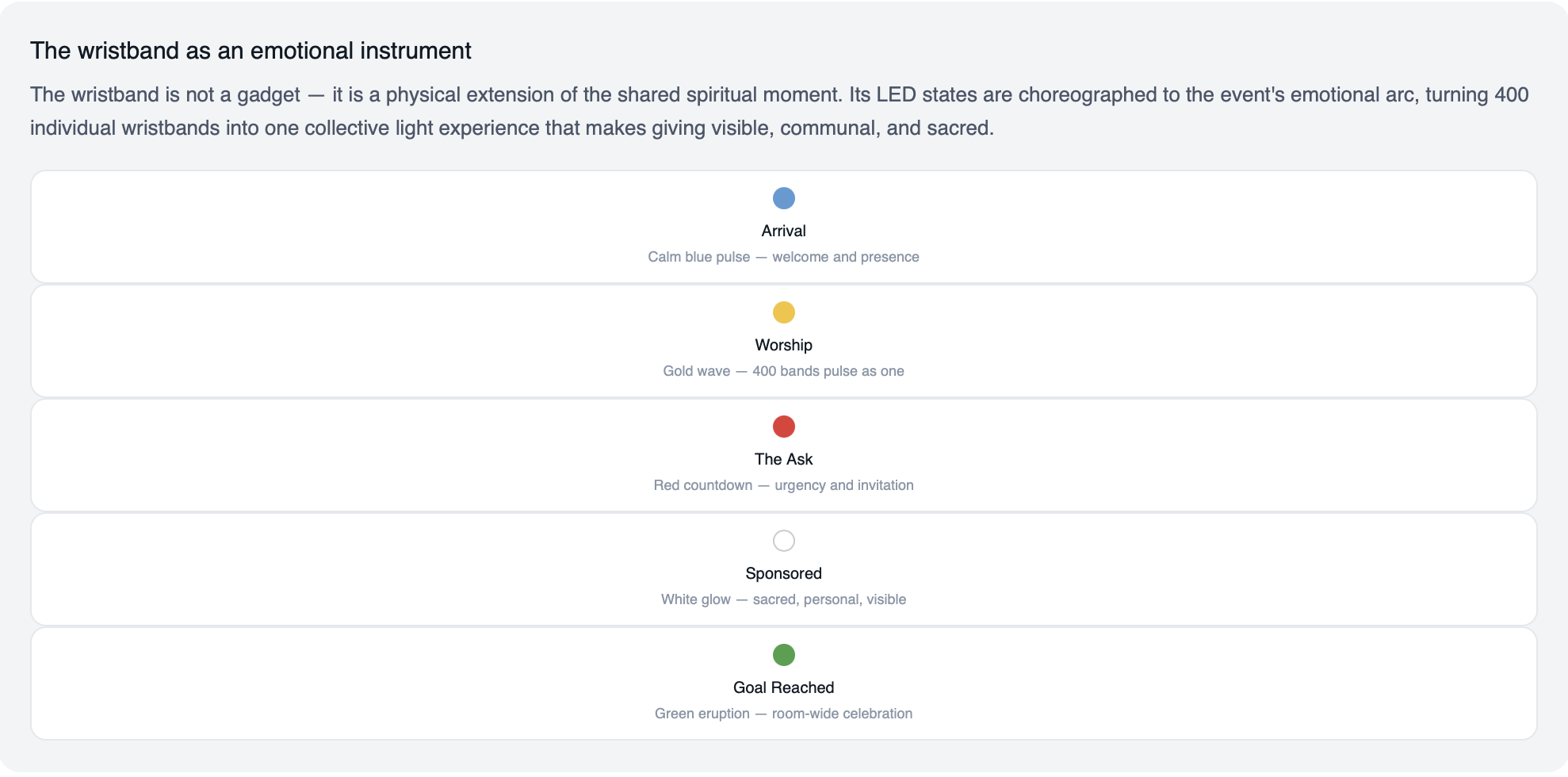
Step 3: Designed the wristband as an emotional instrument, not a gadget
The LED states were choreographed to the event narrative: blue on arrival (welcome), gold pulse during worship (collective joy), red during the countdown (urgency), white glow when a sponsorship is confirmed (sacred, personal), green when the goal is reached (celebration). Every color choice was tied to the emotional arc of the evening.
Method: Physical/digital integration · Emotional design · QR-enabled touchpoints
Step 4: Trained developers on interaction patterns and design hand-off
Led hand-off sessions covering mobile interaction flows, projection data API requirements, and wristband LED trigger logic. Created annotated design specs and a style guide so engineers could build confidently without constant design review — reducing back-and-forth by an estimated 40%.
Method: Developer training · Design specs · Style guide · Cross-functional collaboration
Mobile, Projector Screens, Wristband Designs
Mobile — pre-event screens
Mobile — in-venue screens
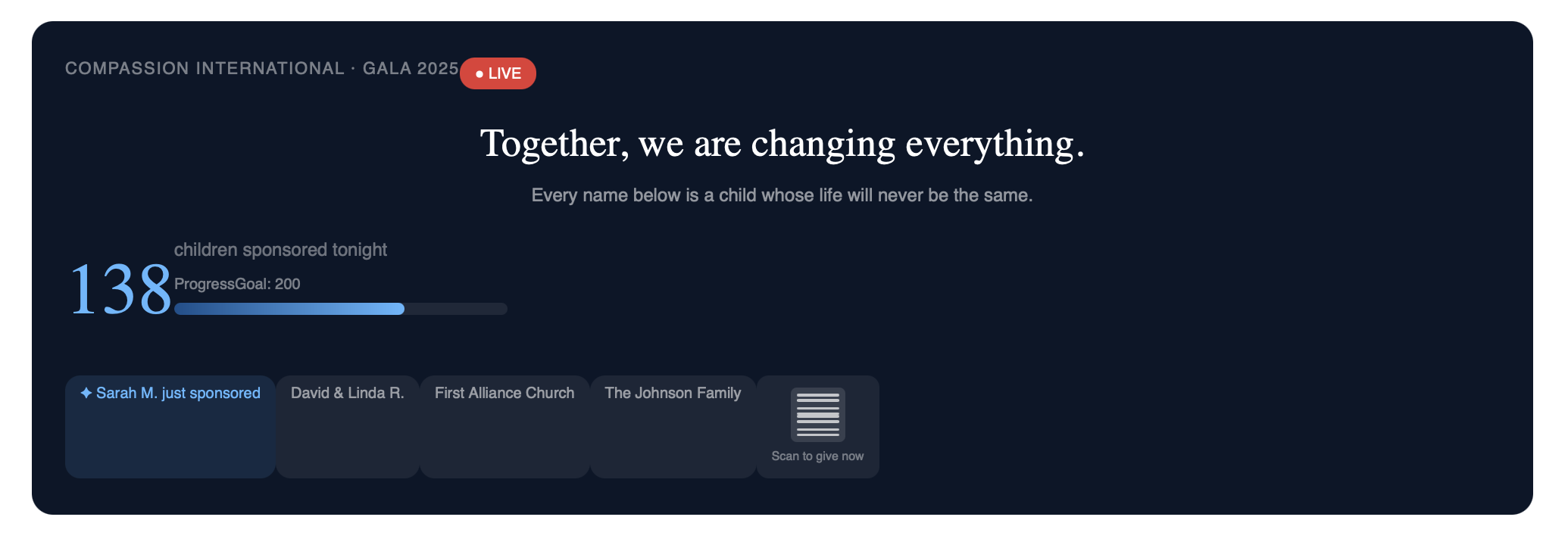
Projection Screen — “live” giving wall
Interactive Wristband — LED state design
Result
What the design achieved
Outcomes were measured through usability testing, stakeholder review, and modeled projections based on comparable live event giving data. The multi-surface design created measurable improvement across all three event phases.
What changed — measured outcomes from usability testing
Usability testing with 12 research-matched participants produced clear, measurable signals that the redesigned experience was achieving its goal. These outcomes formed the basis for projected production metrics presented to product and ministry leadership.
+55% projected increase
of first-week letter send rate
3x re-engagement
Post-event donor re-engagement vs. prior year email baseline
83% of usability participants
said wristband made giving feel "meaningful, not transactional"
Key takeaways
What worked
The wristband white-glow at sponsorship confirmation was the most emotionally powerful moment in testing. Physical feedback made the invisible act of giving visible — and that changed the entire energy of the room.
Cross-surface lesson
Each surface needs a defined role. Mobile is personal. Projection is communal. Wristband is physical/emotional. Discipline in surface definition created clarity and emotional focus — not noise.
What I would do next
Test a "sponsor together" feature — two guests at a table co-sponsoring one child and sharing the white-glow moment simultaneously. Hypothesis: paired giving increases both conversion and long-term retention.
Ministry impact
Design at a fundraising gala is the difference between a room that leaves inspired and a room that leaves committed. Every dollar raised is a child in school, fed, healthy, and known by name. That is what this design was for.
Zulieth Jacobs · Portfolio · Designed for Compassion International — R8062 Product Designer III (Live Events)